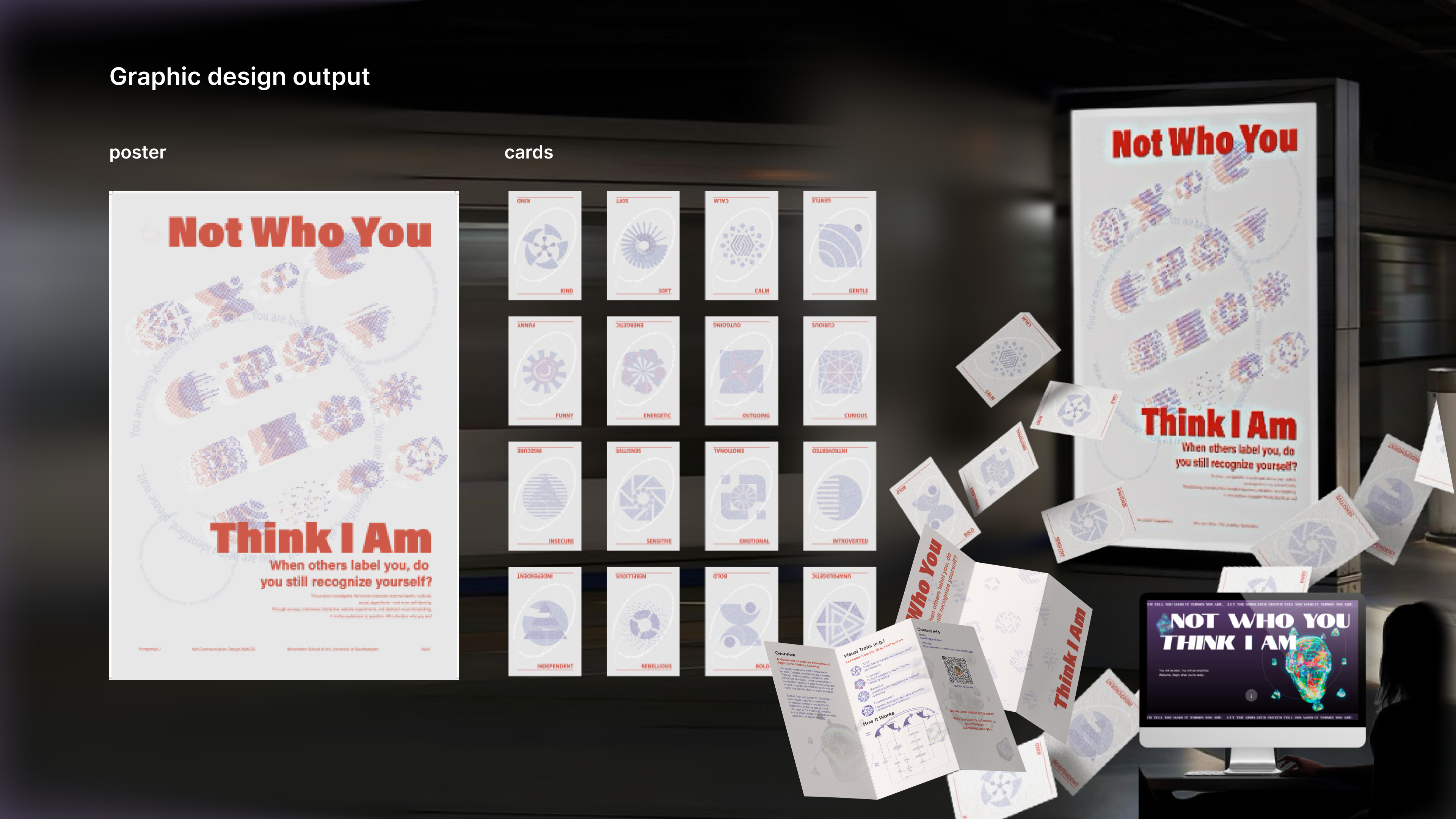
Project Overview
This project explores what it feels like to be seen, judged, and labeled by a system. Through a face-tracking simulation and interactive feedback, users experience a condensed version of algorithmic judgment — and must decide whether to accept or reject the identity they’ve been assigned. Rather than using real AI, the project uses visual logic to recreate the emotional pressure and symbolic discomfort of being categorized. The goal is not technical imitation, but to make visible the often-invisible dynamics of digital labeling.
This project forms a full research loop: from user-centered inquiry and theoretical grounding, to interactive simulation and real-world feedback — not to solve labeling, but to make its tension visible, sharable, and thinkable.

Research
What happens when others label us in ways we don’t recognize?
This question guided both the academic reading and physical research of this project.
Academic Research
Learning directly from people’s experiences
This part of the research draws from sociology, media studies, and cognitive psychology to understand how people react when their identities are simplified by others or technology.
• Becker explains how social labels turn people into “outsiders.” Once labeled, you're treated differently — often excluded or misunderstood (Becker, 1963).
• Goffman shows that stigma emerges when there's a gap between how we want to be seen and how others see us. People constantly manage this gap in daily life — by hiding, reshaping, or resisting their labels (Goffman, 2009).
• Buolamwini & Gebru reveal that facial recognition systems misidentify women and people of color far more often than white men, showing that algorithms reflect social bias, not neutral judgment (Buolamwini and Gebru, 2018).
• Festinger introduces the idea of cognitive dissonance — the discomfort we feel when outside judgment doesn’t match our internal sense of self (Festinger, 1957).
These theories form the foundation for this project’s interactive logic — not to recreate technology, but to simulate the emotional effect of being judged.
.png)
Physical Research
Understanding the psychology and systems behind labeling
To ground the theory in real-world emotion, I conducted surveys and interviews with people aged 18–30. These insights helped shape the tone, pacing, and logic of the interactive website.
• 105 Online Survey Responses: Many respondents said they often feel misunderstood — especially on social media or in public. People are judged quickly, and remembered by one trait.
• 10 Visual Self-Perception Worksheets: Participants compared how they see themselves vs. how they think others see them. The results showed consistent gaps — and quiet frustration.
• 8 In-Depth Interviews: Participants shared emotional moments of being labeled — “too much,” “cold,” “awkward.” Many said those labels stuck, even when they didn’t agree.
These stories confirmed the emotional truth: Being mislabeled is more than annoying. It shapes how people show up, express themselves, or hold back.

Context
From Research to Visual Language
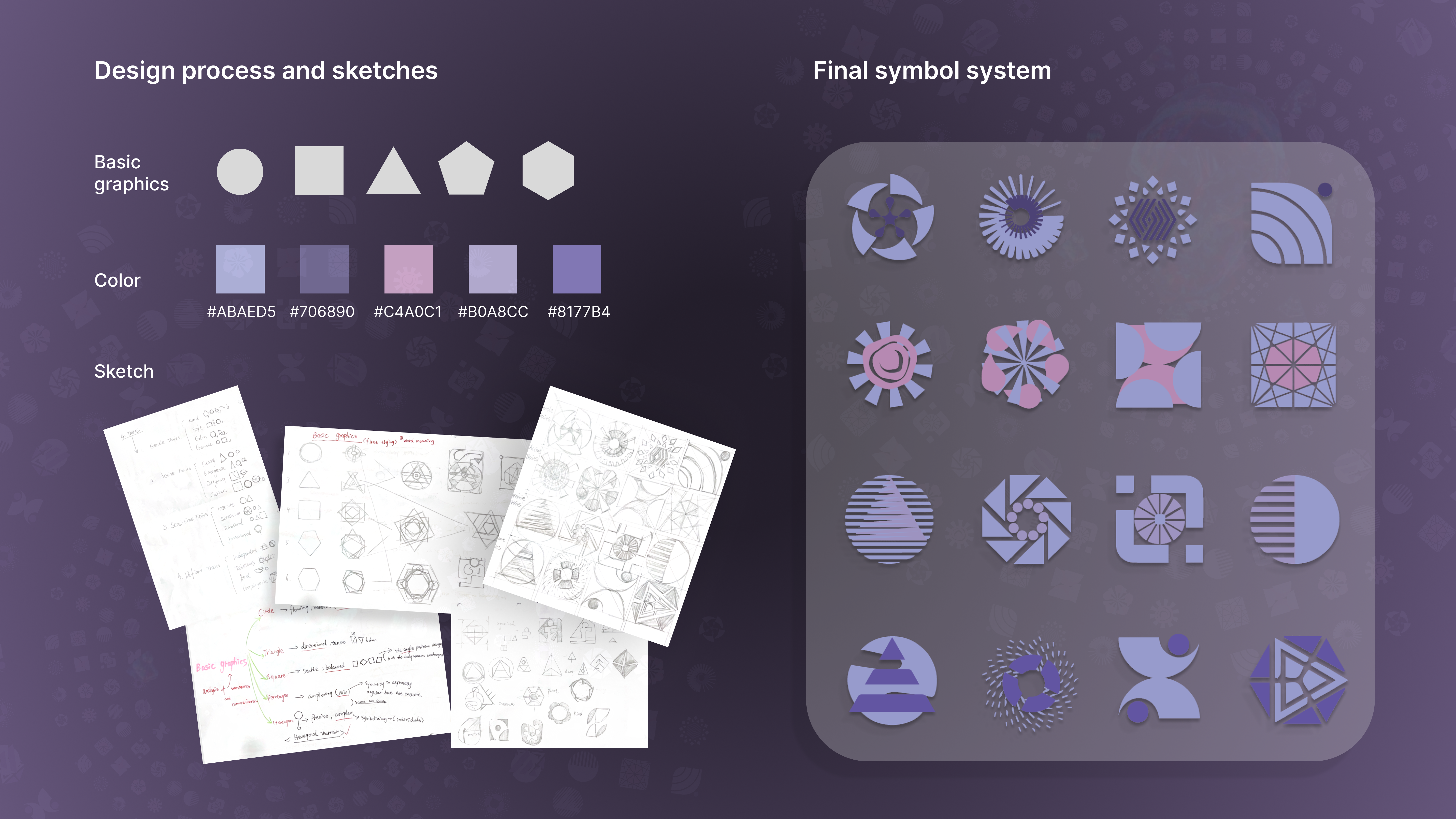
This section illustrates how raw data was transformed into a visual system. Starting with emotional keywords and identity-related responses, I grouped participant input into three overarching categories — forming the foundation for a set of 16 abstract identity traits.
⬇️ The first image below presents the final symbol system: each mark represents one label word, designed through rounds of sketching, abstraction, and iteration.
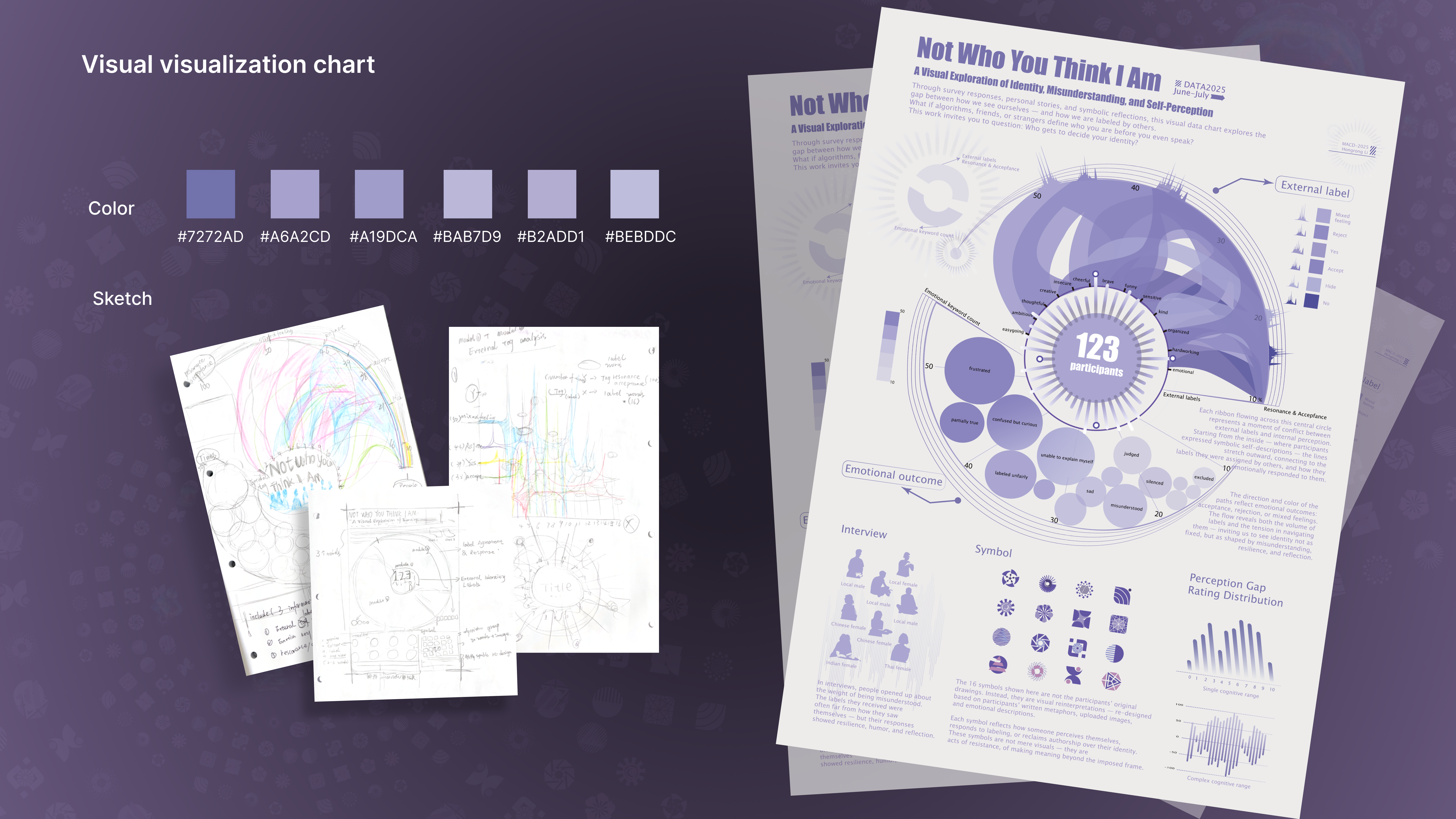
Building on these labels, I reinterpreted the wider data into a visualized chart that maps emotional reactions, perception gaps, and labeling outcomes across all participants.
⬇️ The second image shows how these relationships were visualized — turning emotional and cognitive tension into symbolic flows and data ribbons.
Prototyping Interactive Experiences
Website: Simulating Algorithmic Labeling
The goal of this website is to simulate how algorithmic systems assign identity labels — often quickly, randomly, and without real understanding.
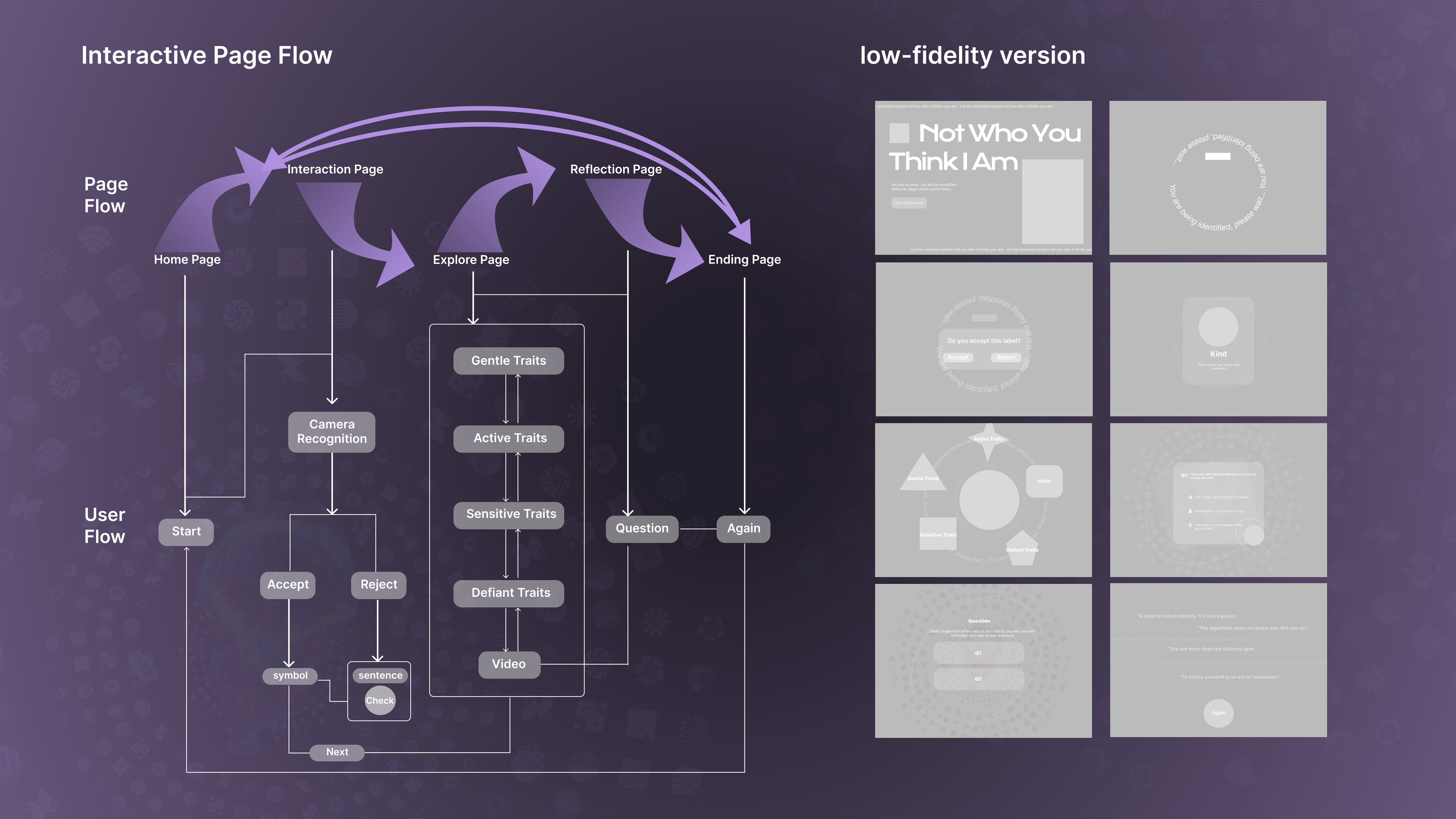
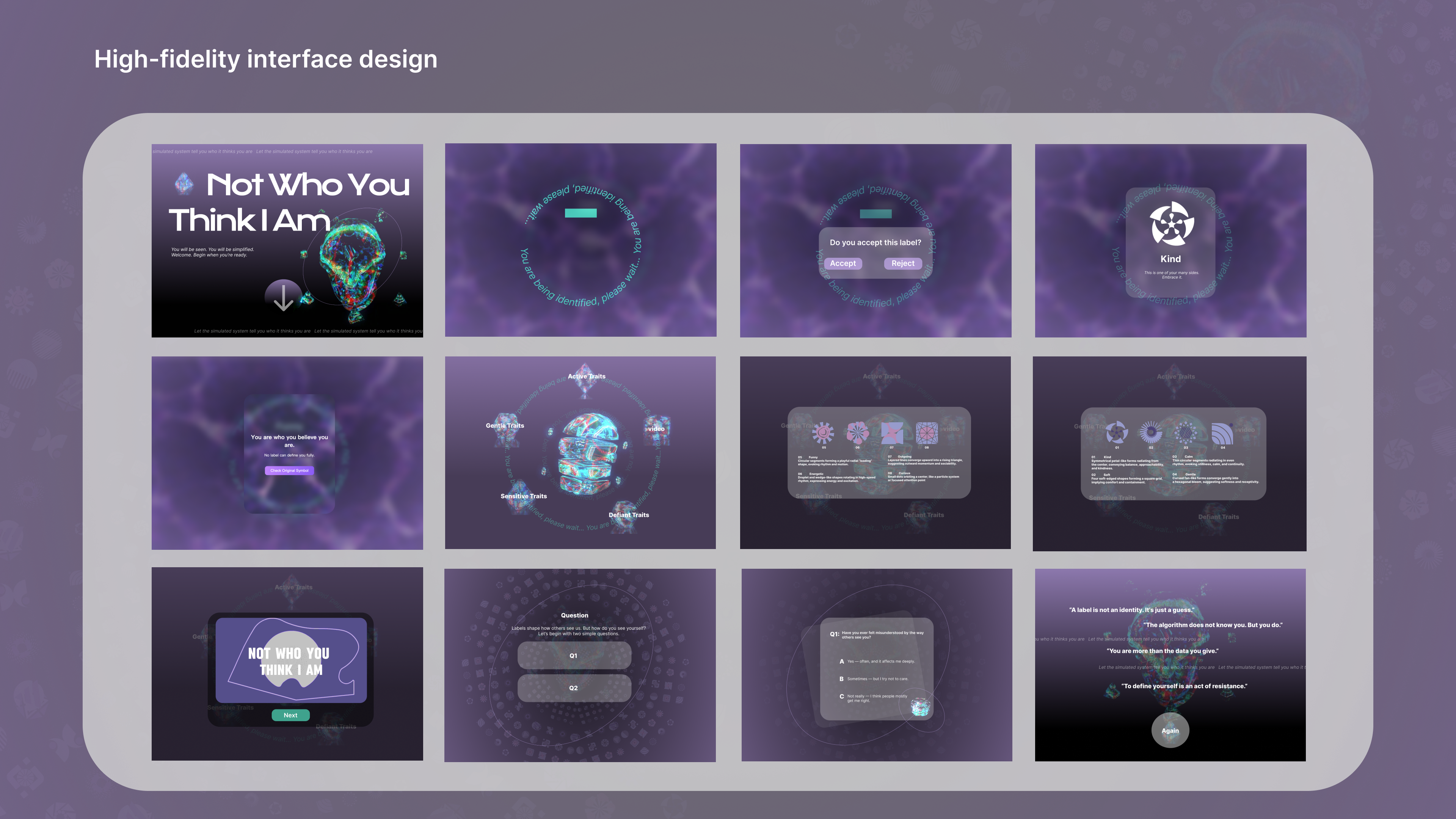
The interaction begins with camera input, then assigns users a visual label, prompting them to either accept or reject it. This symbolic system is deliberately abstract, reflecting how digital judgments can feel vague or detached.
⬇️ The first image combines the overall user flow and early low-fidelity wireframes. This structure mirrors how algorithmic labeling systems operate — looping and impersonal.
⬇️ The second image presents the final high-fidelity interface design.
Integrated Video: Visualizing the Labeling Experience
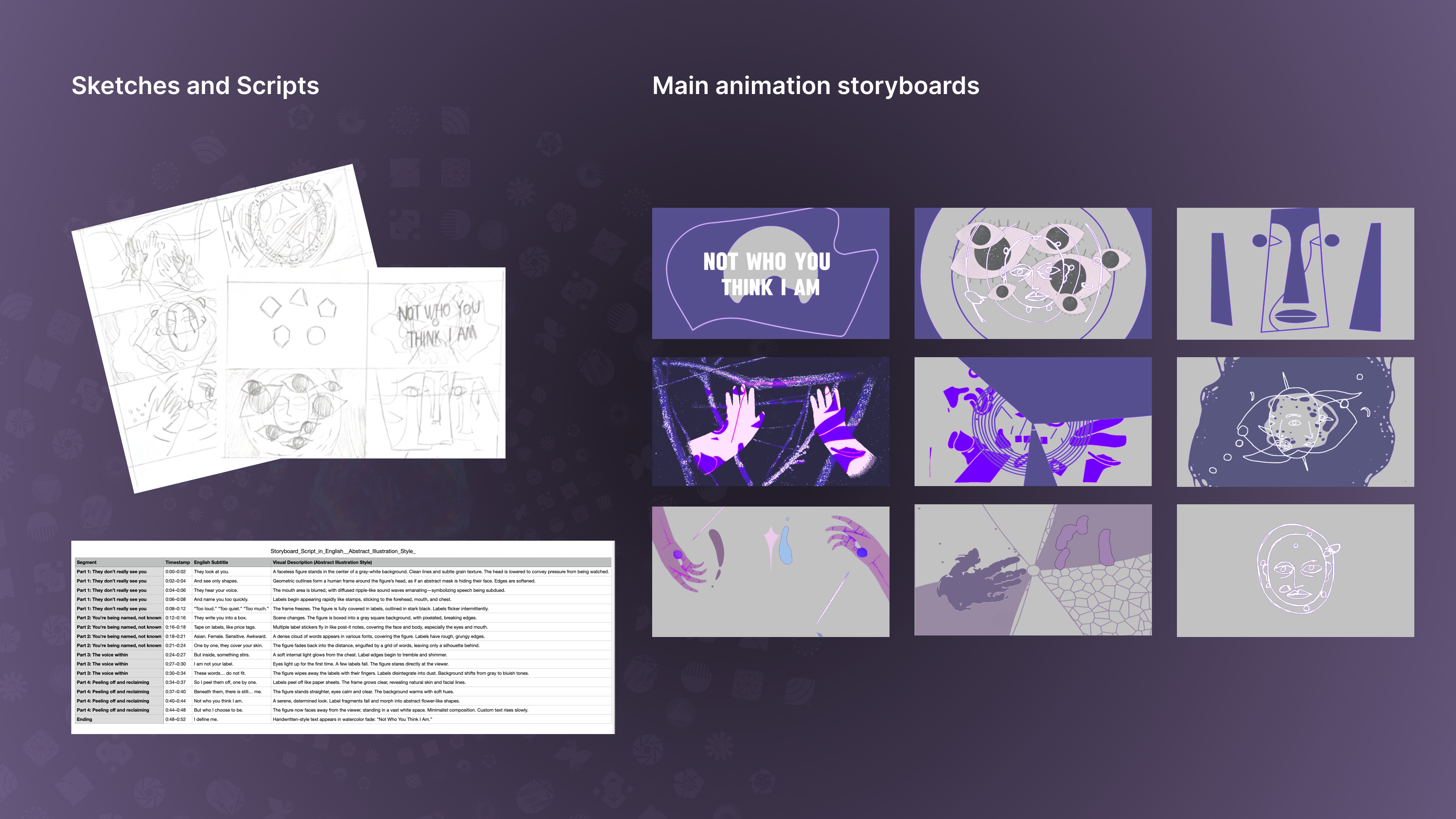
This animation is embedded within the core experience of the website — during the transition between being labeled and exploring the meanings behind those labels.
The first image shows the storyboard and early sketches.
The second section presents the full animation.
Final Outputs and User Feedback
A short video shows how a user interacts with the website — receiving labels, making choices, and reacting in real time. Below, a comparison shows how the same user described themselves before and after the experience.
Website Links:https://not-who-you-think-i-am-nwytia.netlify.app/
.png)