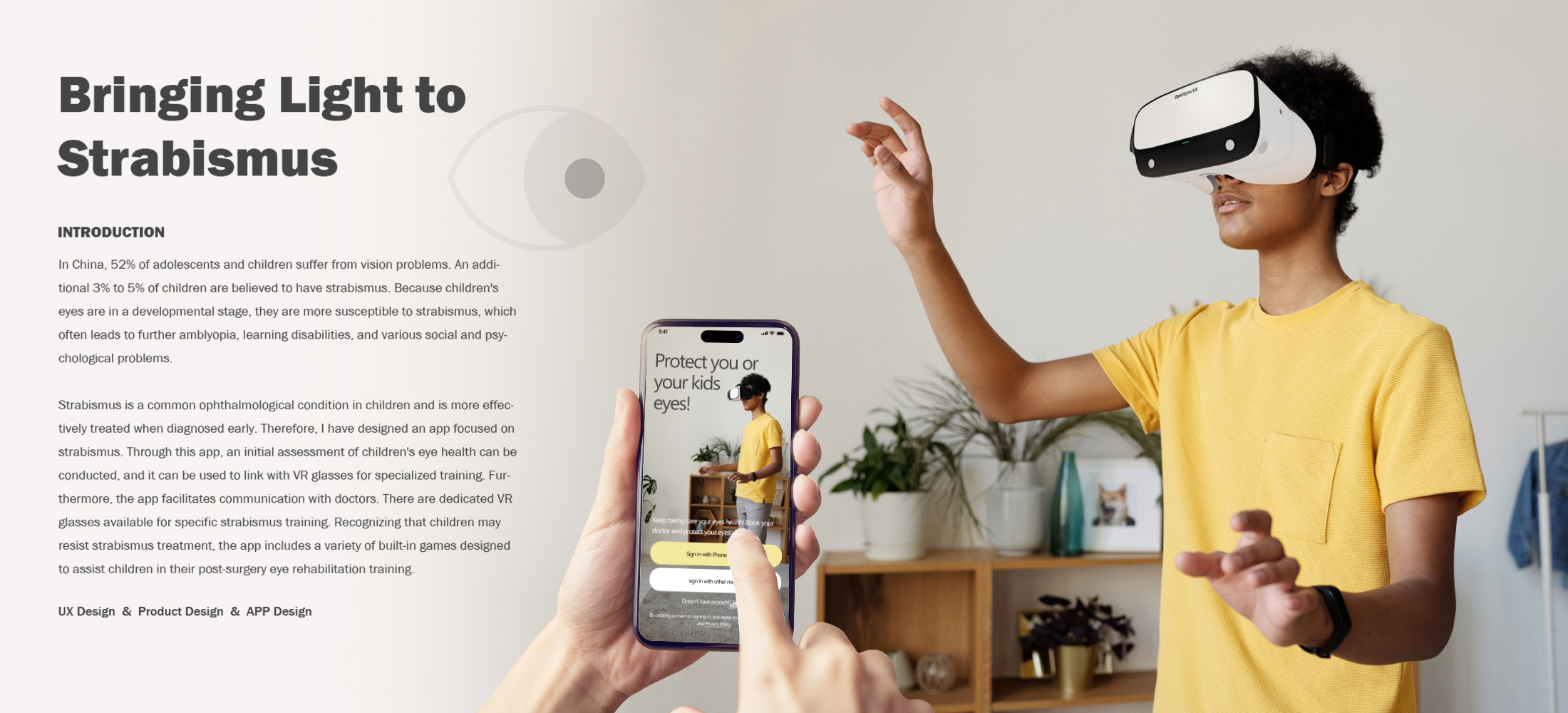
Project Overview
Background
In China, 52% of adolescents and children suffer from vision problems. An additional 3–5% are believed to have strabismus — a misalignment of the eyes during development that, if untreated, leads to amblyopia, learning disabilities, and social challenges. Current solutions are either expensive, clinically inaccessible, or deeply unpleasant for children.
Outcome
A complete ecosystem: a mobile app for initial assessment and doctor communication, and a paired VR headset that transforms rehabilitation into an engaging experience children will actually want to do — combining eye-tracking technology with gamified training.
The Problem with Strabismus Care
Strabismus is most effectively treated early, yet current solutions are either expensive, clinically inaccessible, or deeply unpleasant for children. I set out to design a complete ecosystem: a mobile app and a paired VR headset that transforms rehabilitation into an engaging experience.
How Strabismus Works & Why VR Helps
Strabismus occurs when both eyes fail to send coordinated signals to the brain, which then begins ignoring input from the misaligned eye. Treatment requires training the extraocular muscles — a process traditionally done with patching or cumbersome clinical devices.
VR technology combined with eye-tracking allows us to precisely assess strabismus status, guide coordinated eye movements, and present stereoscopic images at variable depths — making treatment both more effective and more engaging.
The Clinical Opportunity
Eye-tracking built into VR glasses can continuously determine the dominant strabismus type, monitor treatment progress, and adjust difficulty in real time — transforming passive monitoring into active, data-driven rehabilitation.
Why Children Resist Treatment
Traditional strabismus treatment — eye patches, repetitive exercises, clinical instruments — is perceived as boring or stigmatising by children. Gamified VR rehabilitation changes this by embedding therapeutic training into narrative game environments.
System Structure
The app is structured around four core areas, designed so that a parent can intuitively navigate without medical background knowledge.
Home Page
Dashboard showing the child's current strabismus status, upcoming training sessions, and quick links to recent test results.
Strabismus Assessment
Self-testing, strabismus type explanation, mitigation advice, eye-tracking training, and step-by-step rehabilitation guidance — all accessible without a clinic visit.
Device Integration
Binding VR glasses, viewing synchronised training data, equipment status, and year-over-year health data to track long-term progress.
Appointment & Forum
Book online video consultations with doctors, post in the community forum, private chat with specialists, and access support resources.
Personal Profile
Individual medical plan, basic disease information, progress reports, and family login for parents to manage their child's care remotely.
Smart Reminders
Customisable training schedule notifications, medication reminders, and automated alerts when assessment results indicate deterioration.
Key App Screens & Interaction Flows
The app was designed with two primary users in mind: children aged 6–14 who will use it directly for training, and parents who manage appointments and review progress. The interface uses a warm yellow palette — approachable, playful, and distinct from cold clinical aesthetics.
Login & Registration
Separate onboarding flows for patients and family members. Simple, large-touch-target design for children and elderly parents alike.
Strabismus Self-Test
Step-by-step visual assessment using the device camera. Results are colour-coded and explained in plain language.
VR Training Sync
Real-time connection to the VR headset. Displays binocular coordination progress bars and syncs historical training data.
Doctor Video Call
One-tap connection to a specialist. The app shares the child's most recent assessment data automatically before the call.
.jpg)
.jpg)
.jpg)
.jpg)
VR Rehabilitation Device
The VR headset was designed specifically for children in strabismus treatment — lightweight, adjustable, and visually appealing enough that children want to wear it. The product integrates directly with the app, creating a seamless feedback loop between training and monitoring.
.jpg)
.jpg)
.jpg)
Lessons from the Project
Designing for Children Requires Rethinking Everything
Adult UX heuristics don't translate directly to children's interfaces. Motivation, attention span, and the role of caregivers as intermediaries all change the design calculus significantly.
The gamification approach came not from aesthetics but from research: children who found strabismus treatment "boring" were significantly less compliant. Embedding therapy in play was a clinical decision as much as a design one.
The Ecosystem Advantage
Designing the app and VR device in parallel meant that constraints in one shaped the other productively. The eye-tracking data available from the headset informed which visualisations were even possible in the app — and the app's information architecture highlighted which training data was actually useful to surface. This tight integration is what differentiates the system from competitors who offer either a device or a digital tool, but not both.
Of Chinese children affected by vision problems during development
Integrated products — mobile app + VR rehabilitation headset
Core app modules covering the full care journey