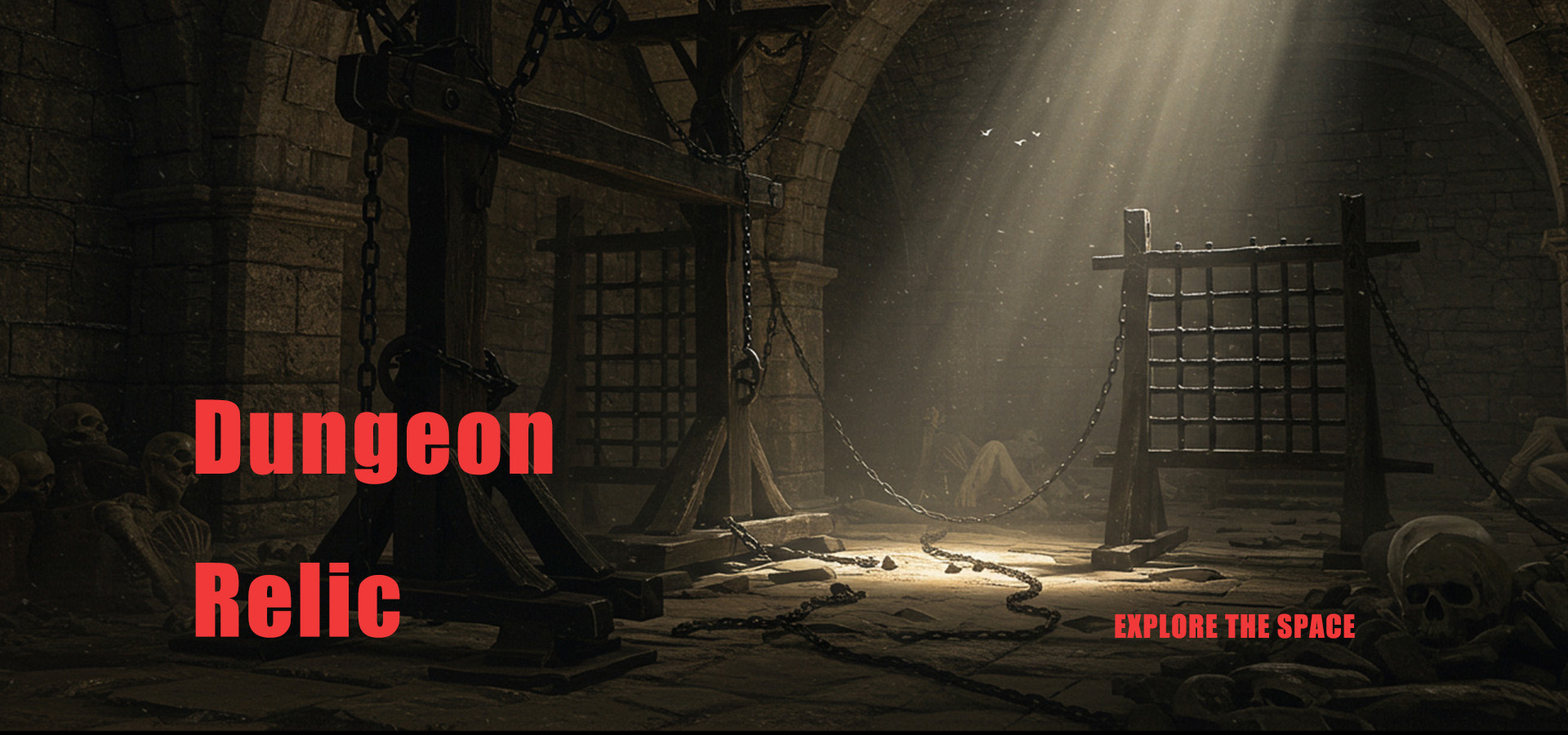
Content Notice: This project contains historical documentation and depictions of medieval torture instruments. Recommended for audiences aged 16 and above. All material is presented in a critical, educational context — not to sensationalise violence, but to examine how power, fear, and spectacle shaped public justice throughout history.
Project Overview
Background
Sparked by an accidental visit to a Berlin museum housing historical instruments of torture, this project transforms those unsettling encounters into a critical digital experience. Grounded in Michel Foucault's Discipline and Punish, it asks: when science meets power, what becomes of the body? Rather than sensationalising cruelty, it offers a reflective space to examine how mechanical innovation was once weaponised to enforce control.
Outcome
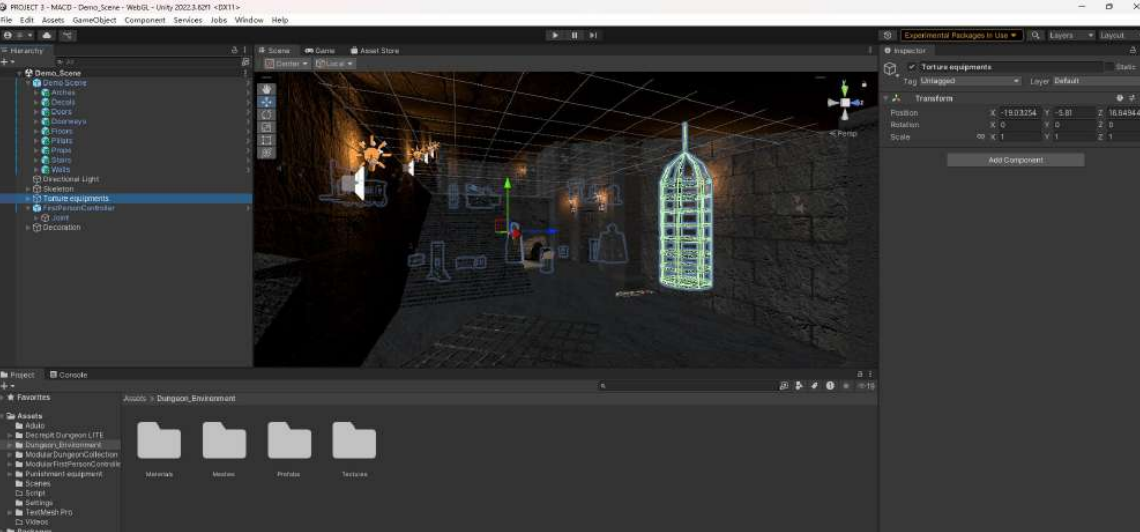
A text-adventure game built in Unity 3D, where the player explores a reconstructed dungeon environment, encounters historical instruments, and engages with layered narratives voiced through AI-generated narration. After Effects handles the interactive UI — subtitles, choice selection, and motion graphics — while Unity drives first-person 3D exploration and object rendering.
Why Torture Instruments?
The project began with a single unsettling image encountered online — torture devices from the Science Museum in London. The brutal mechanical ingenuity behind them prompted a museum visit in person, and later an extended research trip to a Berlin exhibition dedicated entirely to instruments of punishment. What emerged was a question that design could not ignore: how does an institution present cruelty?
The body is directly involved in a political field; power relations have an immediate hold upon it; they invest it, mark it, train it, torture it, force it to carry out tasks.
Michel Foucault — Discipline and Punish: The Birth of the PrisonThese objects are not mere relics of the past — they are machines that expose the darker applications of scientific thinking. The project critically examines how power, fear, and spectacle once shaped public justice, and how contemporary digital tools can reframe that history as a space for ethical reflection.
Audience & User Research
People
Young adults (16–35), university students, history enthusiasts, fans of dark tourism and interactive narrative games. Adults over 35 drawn to the ethical dimension of the work.
Activities
Navigating a first-person dungeon, making narrative choices, reading and listening to historical accounts, reflecting on the ethics of power and punishment.
Contexts
Digital exhibition context, personal desktop exploration, museum companion piece, or academic viewing. Recommended for ages 16 and above.
Technologies
Unity 3D WebGL build embedded in browser, After Effects-rendered video sequences, AI-generated voice narration via ElevenLabs.
User Personas
Alex, 19
History student. Wants to understand the connection between punishment and social power. Comfortable with game narratives and interactive media.
Jessie, 23
Design student, frequent museum visitor. Motivated by the tension between violence aesthetics and ethical design. Sensitive to tone and framing.
Marcus, 38
Criminal justice researcher. Seeks rigorous historical grounding alongside the interactive experience.
Objects Under Study
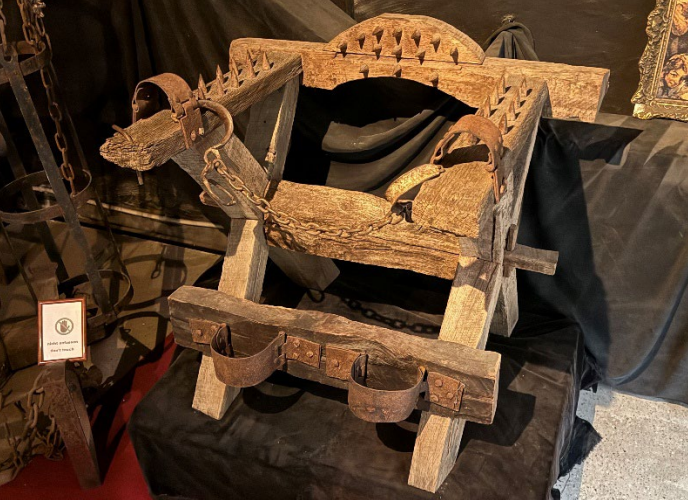
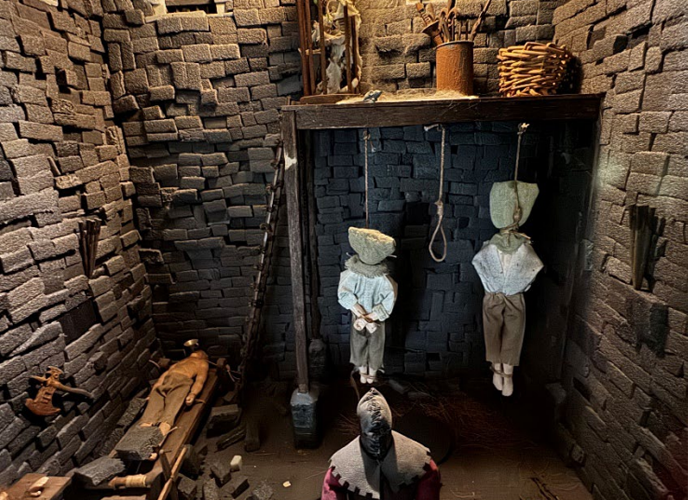
Three primary objects from museum collections anchored the research — each chosen for its distinct mechanical logic, historical significance, and symbolic weight.
The Thumbscrew (France, 1601–1850)
Its ingenious spiral structure embodies the principle of mechanical pressure — one of the most engineered instruments ever produced. Designed not to kill but to maximise pain, it represents the deep entanglement between technology and violence.
Model Iron Maiden — "Virgin of Nuremberg"
Though possibly a later reproduction, it has become the definitive symbol of medieval torture. The contrast between exterior and interior is striking: disguised as the Madonna on the outside, concealing iron spikes within. As a symbolic device, it provokes reflection on moral pretense and institutionalised violence.
Iron Torture Gibbet (1501–1800)
Used both for imprisonment and public display, gibbets turned punishment into spectacle. Skeletal remains beneath stone pillars suggest not all prisoners saw daylight — the cage itself became a warning to the living.
Primary museum objects studied in depth
Institutions visited: London Science Museum + Berlin
Recommended audience age for the experience
Character Path & Story Structure
The experience is structured as a text-adventure journey, borrowing from Japanese visual novel conventions and dark tourism's approach to difficult history. The player is not a passive viewer — they are an investigator, making choices that shape how deeply they engage with each instrument.
From the Getting Started screen, the player discovers the dungeon environment, receives historical narration, selects a torture device to examine (Head Crusher, Tiger Bench, or Mujia), witnesses a reconstructed video sequence, and arrives at a closing emotional reflection on human rights and civilisation.
In the presence of these cold instruments of torture and shadowy relics, we see not only the cruelty of history, but also the struggle of civilisation. History is never just the past; it is always relevant to our future.
Closing Narration — Dungeon RelicsProject Walkthrough
The video below documents the full Dungeon Relics experience — from the opening title sequence through dungeon exploration and into the reflective conclusion. Narration is delivered by an AI-generated elderly voice (ElevenLabs), chosen for its sense of historical authority and gravitas.
Project Documents
The project presentation and field research logbook are available below. The presentation covers the conceptual foundation, museum research, narrative path design, interface sketches, and ethical framing. The logbook documents the museum field trip to Berlin.
Project Presentation
Full project slides: motivation, museum collection research, ethical framework, narrative structure, Unity development process, AE interface design, voice and tone decisions, and future directions.
Open PDF ↗Museum Field Trip Logbook
Documentation of the Berlin museum visit — personal reflections on encountering the instruments, audience analysis, and photographic records including the Thumbscrew, Gibbet, Torture Chair, and Heretic's Fork.
Open Logbook ↗Project Presentation — Embedded
Visual & Interface Sketches
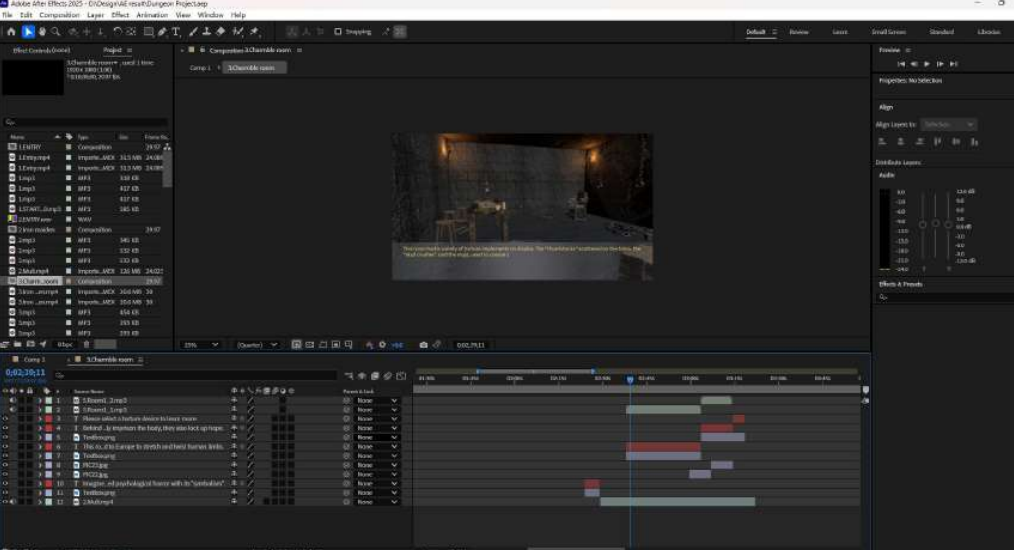
The visual language draws from Japanese text-adventure conventions and dark historical aesthetics. After Effects was used to craft the full interactive interface: opening screens, subtitles, image display sequences, video playback, choice selection panels, and motion transitions between scenes.
Voice & Narration
All narration was generated using ElevenLabs' "Grandpa Spuds Oxley" voice on the Eleven Multilingual v2 model — an elderly, measured tone chosen for its sense of authority and historical weight, ensuring clarity and gravitas across all narrative sequences.
Tutor Feedback
Eleven areas of feedback were received at the mid-project critique. Each informed a concrete revision to the project.
- 01Sketchbook too thin — Added literature research, visual sketches, original inspirations, reference images, and experimental development screenshots to deepen the research process documentation.
- 02Title not clear — Revised to the full title: Dungeon Relics — An Interactive Exploration of Historical Instruments of Torture.
- 03Project position not clear — Reframed explicitly as a critical examination of historical violence, power, and ethical boundaries through digital interaction.
- 04No clear journey starting point — Introduced a clear audience-journey design with an opening atmospheric prompt and step-by-step guided exploration.
- 05Museum collection not specified clearly — Clarified specific collections used, linked sources, and distinguished between real archival objects and fictionalised scene elements.
- 06Narration voice too cheerful — Re-recorded with a calm, neutral tone more appropriate to the content's gravity; adjusted ElevenLabs parameters for greater restraint.
- 07Quotes not attributed — Added inverted commas and footnotes throughout to clearly distinguish original narrative text from quoted sources (Foucault etc.).
- 08Text pacing too fast — Redesigned the After Effects timeline with slower, more readable text reveal timing and adjusted credit sequence pacing.
- 09Audience not defined — Added explicit age guidance (16+) and audience framing at the entry point of the experience.
- 10–11Gruesome content handling — Added content anchors so users can skip graphic sequences; replaced visually stimulating imagery with historically contextualised notes to respect audience comfort.
Key Takeaways
What I learned
• Technology is not neutral: In history, it has been precisely engineered to inflict pain and control the body. Visualising violence demands constant negotiation between narrative tension and ethical restraint.
• Design as critical practice: Transforming historical torture devices into digital interaction was not merely a technical challenge — it was a sustained reflection on power, spectatorship, and moral boundaries.
• Museums as ethical actors: The project changed how I see museum artefacts — not as inert historical objects, but as living political legacies whose display is itself an ethical act.
Limitations & next steps
Current limitations
• The Unity build depends on third-party 3D assets, limiting fidelity of object representations.
• AE-rendered sequences and Unity environment operate as separate components — tighter integration would create a more seamless experience.
Future priorities
• Museum Expansion: Develop into a suite of digitally immersive exhibition content — audio guides, background panels, and interactive stations for physical museum spaces.
• Serious Game: Prototype a fuller version with branching narrative paths and player consequence systems — making ethical engagement the core mechanic.
• VR Integration: Explore VR adaptation of the dungeon environment to make the historical weight more physically felt.