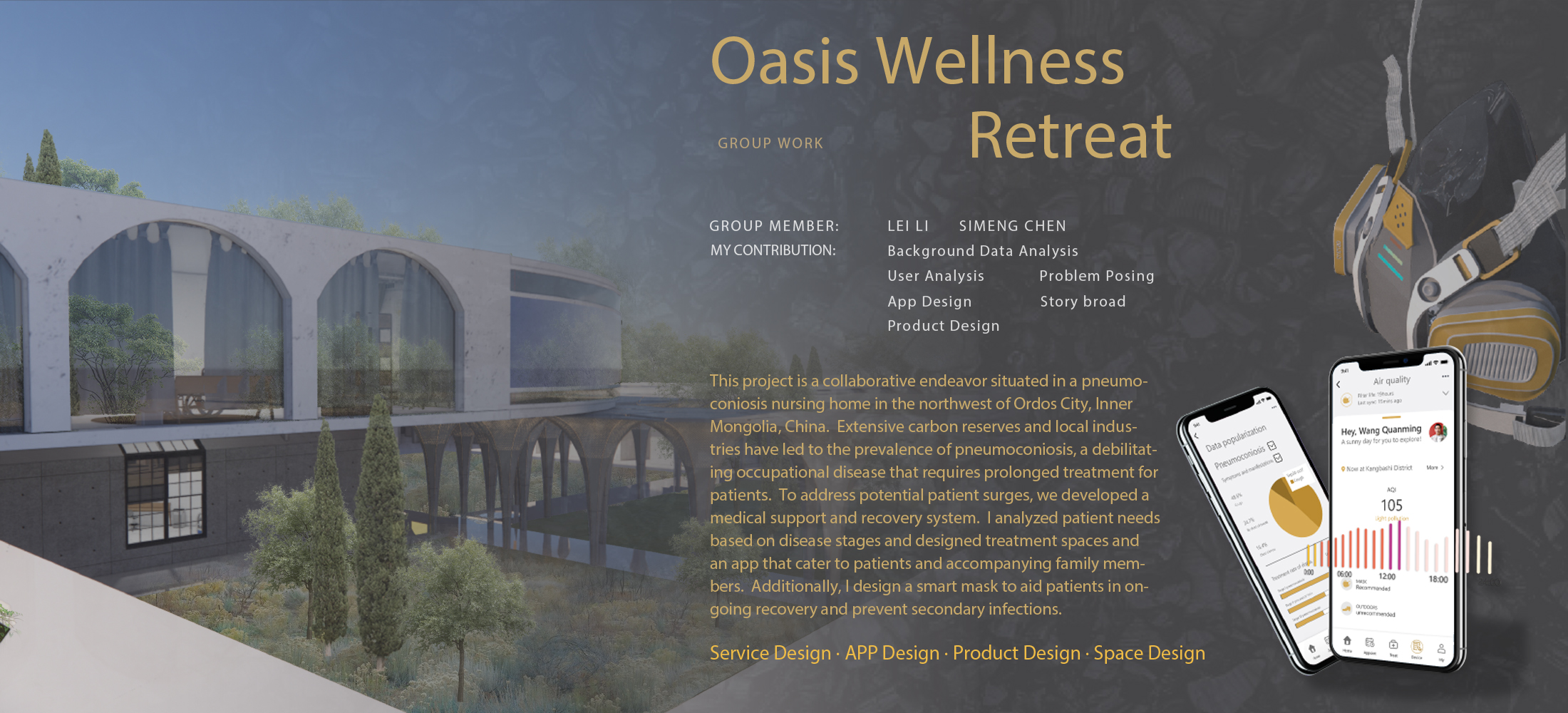
Project Overview
Background
Pneumoconiosis accounts for over 90% of occupational diseases in China, predominantly affecting coal miners in resource-heavy regions like Ordos. Patients require prolonged convalescent care and face significant challenges in receiving adequate support — from disease monitoring to family coordination and post-discharge management.
Outcome
A comprehensive ecosystem addressing the full recovery journey: from the physical sanatorium environment to a digital companion app and a smart wearable mask — all designed to work together as a coherent service system for patients, families, and medical staff.
The Challenge
Our team designed a comprehensive ecosystem that addresses the full recovery journey: from the physical environment to digital tools and a wearable smart mask.
Context
Ordos City, Inner Mongolia — China's top coal reserve region with 2,102 GT of proven reserves and over 450,000 annual pneumoconiosis cases.
Users
Pneumoconiosis patients across three disease stages, their accompanying family members, and the medical staff managing long-term rehabilitation.
Goal
Design an integrated system — space, app, product — that supports full medical recovery, reduces patient anxiety, and prevents secondary infections.
Understanding the Disease & Context
We began with in-depth analysis of pneumoconiosis pathogenesis, disease grades, and the socio-economic context of Ordos. The mining industry accounts for 57.75% of the local economy, making occupational lung disease a deeply systemic issue.
Pneumoconiosis progresses silently through three stages — from initial nodules to severe pulmonary fibrosis — making early detection and long-term monitoring essential to patient survival.
Pathogenic Factors
Coal dust, asbestos, silica, metallic dust — all generating airborne particles that cause irreversible fibrosis over time.
Scale of Impact
450,000+ new cases annually in China, with Ordos disproportionately affected due to its extensive coal and construction material industries.
Site Selection
The sanatorium site in Ordos offers natural grassland surroundings ideal for therapeutic recovery, away from primary industrial zones.
.jpg)
.jpg)
.jpg)
Three Problem Dimensions
Through user analysis, we identified three core challenges that shaped the entire design system.
Modular Sanatorium Architecture
The building adopts a modular engineering principle: a core "minimal unit" that can be combined and scaled based on patient volume. The layout separates patients' routes from medical staff routes, with generous green land integrated into the campus to promote natural healing.
Phase III ward blocks are added progressively, and the registration area anchors the entrance flow — ensuring patients never feel lost in the system.
.jpg)
.jpg)
.jpg)
Smart Health Companion App
The mobile app serves both patients and family members with real-time air quality monitoring, medication management, appointment scheduling, and community support. The warm gold palette echoes the "oasis" concept — calming and trustworthy for elderly users.
Air Quality Dashboard
Real-time AQI monitoring with time-series charts and automated mask-wear alerts when pollution levels reach serious thresholds.
Medication Management
Prescription-linked dosage reminders with visual progress tracking — helping patients maintain strict medication schedules during long recovery.
Family Connection
A dedicated family portal lets relatives stay informed about patient status, schedule visits, and receive health updates from medical staff.
Post-Discharge Follow-up
Automated reexamination reminders and telemedicine consultation access ensure continuity of care after patients leave the sanatorium.
.jpg)
.jpg)
.jpg)
Pneumoconiosis Protective Mask
Inspired by gas masks but deliberately stripped of their bulk, the smart mask reimagines protection through transparency and lightness. The form draws from traditional respirator silhouettes while eliminating features patients found uncomfortable.
Visual Breathing
Transparent panels allow carers and family to see the patient's face, reducing the psychological isolation often associated with mask-wearing.
Air Quality Indicator
An embedded light changes colour based on real-time pollution data. Red light + audio cue alerts the wearer and syncs a push notification to the app.
Coconut Shell Filter
Activated carbon derived from coconut shell provides high-efficiency particulate filtering in a lightweight, replaceable cartridge format.
What We Learned
Systems Thinking in Healthcare
Designing across four disciplines simultaneously forced us to consider how each element influences the others. A mask that syncs with an app, inside a building that displays AQI, within a service that tracks long-term health — every piece had to be coherent.
The modular architecture was a significant lesson: designing for scalability avoids the costly retrofitting that plagues most healthcare facility planning.
Designing for Vulnerability
Many patients are elderly miners with limited digital literacy. Every interface decision — larger touch targets, simple iconography, warm colours — was a direct response to user research findings about this specific population. Collaborating with Simeng reinforced the value of interdisciplinary work: her architectural instincts and my UX focus created productive tension that produced a more considered outcome.
Design disciplines integrated into a single ecosystem
New pneumoconiosis cases annually in China
Core user groups — patients, families, medical staff