Project Overview
Background
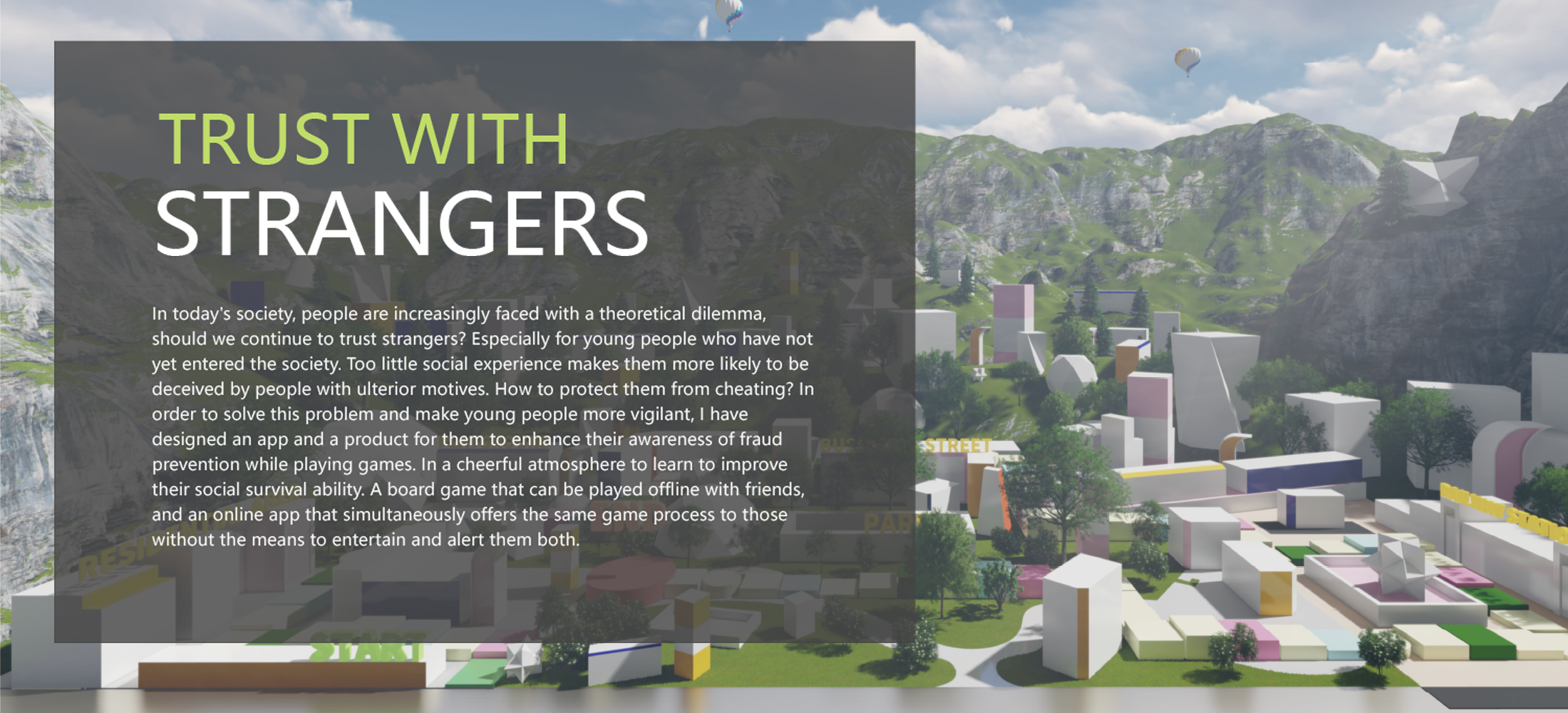
In today's society, young people who have not yet entered social life are more likely to be deceived by people with ulterior motives — not due to lack of intelligence, but a lack of learned social survival skills. This project explores how game design can be a more effective teacher than lectures or warnings.
Outcome
A dual-format experience: a physical board game playable with friends offline, and an online app version that expands access to those without people to play with — both teaching the same vital lesson through lived decision-making across a 3D cityscape.
The Dilemma of Trusting Strangers
I designed a dual-format experience: a physical board game playable with friends offline, and an online app version that expands access to those without people to play with — both teaching the same vital lesson through lived decision-making.
Root Problem — Blind Trust
Blind choices are decisions made without adequate information and knowledge, which often lead to adverse consequences — yet we rarely teach young people how to spot them.
Root Problem — Stupid Behaviour
When people pay a price for a situation and the result backfires, the situation becomes worse than before. Good intentions with bad judgment create harm.
Defining Trust as a Design Problem
Trust is essential to the development of human relationships — it creates mutual understanding, support, and respect. But it also creates vulnerability. I researched three core dimensions of trust that shaped the game's design goals.
Trust is not blind kindness. Doing good must account for third-party interests, the conditions of the act, and whether the help is sustainable and self-saving for all parties.
Show the Impact of Trust
The game reveals how trust — given or withheld — ripples across interpersonal dynamics. Players experience both the rewards of appropriate trust and the consequences of misplaced confidence.
Authenticity of Information
How do you distinguish authentic information from manipulation? The game forces players to assess credibility with incomplete data.
Avoiding Blind Following
Players must learn to pause, evaluate, and choose — not because they distrust everyone, but because they understand the conditions under which trust is warranted.
Competitor Analysis
Reviewed Seek Wealth and God, Multi-Millionaire, and Formula D to extract the strongest structural elements for each layer of the game.
Who This Is Designed For
Primary persona: young adults entering social life who are naturally trusting and at elevated risk of manipulation.
Persona — Adeline, Age 18
A gentle, innocent student who always believes in the goodness of human nature. She is easy to trust people — not suspicious — and therefore easy to deceive by rhetoric she hasn't encountered before.
Needs
Be more alert to others. Discern true intentions. Protect herself from being cheated.
Pain Points
Vulnerable to deception. Difficult to say no to requests. Unable to judge others' intentions.
Goals
Help people who really need it. Protect self and property while remaining kind.
Board Game Mechanics
The game takes place across a 3D cityscape divided into four scenes: Residential Area, Commercial Street, Railway Station, and Park. Players move from Start to Finish by navigating events and triggering scenario-based trust dilemmas.
Movement System
4-sided dice increase randomness. Players navigate through 16 rooms. Correct judgements allow forward movement; failures result in a move back.
Four Scenes
Residential Area, Commercial Street, Railway Station, Park — each with unique event types reflecting real social contexts where trust decisions occur most often.
Four Card Types
Event cards (trigger scenarios), Skill cards (First Aid / Hawkeye / Quick Reaction), Opportunity cards, and Effect cards (Swap / Reverse).
Scoring System
Good deeds done with bad judgment are penalised, not just bad intentions — reflecting real social complexity.
.jpg)
.jpg)
.jpg)
From Concept to Final Board
The game went through four major design iterations before reaching its final form — each one responding to a core weakness discovered in the previous version.
Digital Companion App
The app version brings the same game mechanics to players who can't gather physically, while also enabling online matchmaking and map-view features not possible in the physical format. The UI uses a playful but clean aesthetic that mirrors the 3D game world — colourful, spatial, and exploratory.
Map View
A bird's-eye view of the cityscape game board, showing all players' current positions, available actions, and event zones.
Player Profiles
Each player has a character avatar and persistent skill card inventory. The app tracks historical game decisions and surfaces patterns in the player's trust behaviour over time.
Online Matching
Players without physical friends can join online lobbies and experience the full game digitally, with support for asynchronous play.
Scenario Playback
After each game, players can review their key decisions — seeing what actually happened and reading a short reflection on what a different choice would have led to.
.jpg)
.jpg)
.jpg)
.jpg)
What This Project Taught Me
Games as Ethical Teachers
Designing a game for social awareness forced me to think about how experience teaches in ways that information does not. A lecture on fraud prevention is forgettable. A game where you suffer real consequences — even simulated ones — is remembered viscerally.
The biggest design challenge was ensuring that the ethical lesson wasn't preachy. The game needed to feel fun first and educational second, even though the learning was the entire point.
Physical + Digital Synergy
Designing the physical board game and the app simultaneously revealed how each medium has unique strengths. The physical game creates social conversation. The app extends reach and adds persistence that a boxed game can't offer. Treating them as complementary rather than alternatives shaped every feature decision in both formats.
Design iterations from concept to final board format
Urban scenes with unique scenario types
Formats — physical board game + digital companion app